
An honest look at what parents are paying for—and how to determine whether a martial arts program is worth the investment.
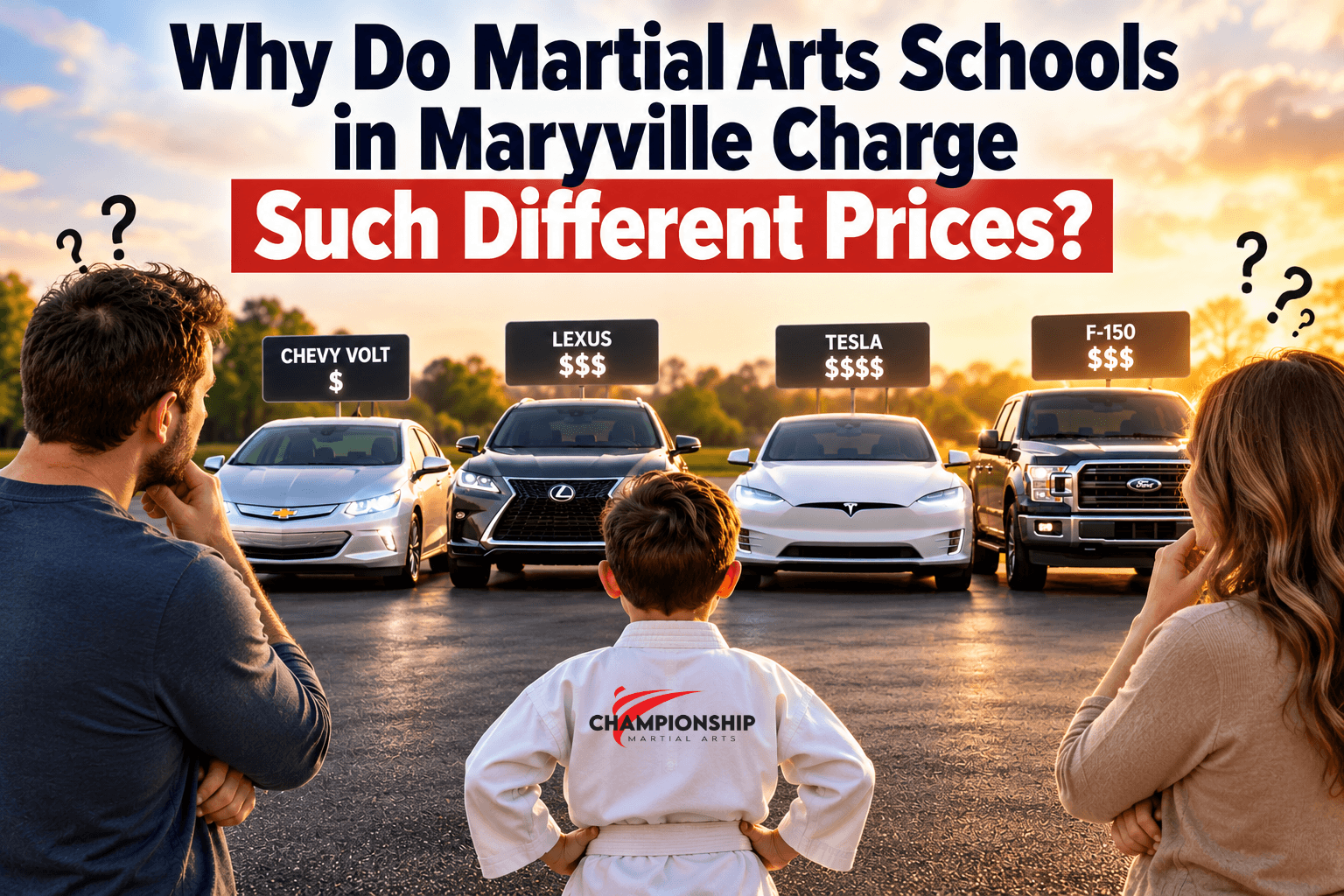
If you’ve been researching martial arts classes for your child in Maryville, Tennessee, you’ve probably discovered something interesting: Not all martial arts schools charge the same amount.
Some programs are relatively inexpensive. Others require a considerably larger financial commitment. Why? After all, isn’t everyone basically teaching kids how to kick, punch, and earn belts? Not exactly.
Think about buying a car.
A Chevy Volt, Lexus RX, Tesla S, and Ford F-150 all have something in common. They’ll get you from point A to point B. But that’s about where the similarities end.
Each offers something different. One buyer might prioritize affordability and efficiency. Another might want luxury and comfort. Someone else might value technology and performance, while another needs the versatility of a pickup truck.
They all provide transportation, but they aren’t designed to deliver the same experience, and nobody is particularly surprised that they come with different price tags.
Here’s something else worth considering: A $70,000 truck isn’t necessarily a better purchase than a $25,000 car. If you’re hauling equipment every day, that truck might be worth every penny. If you’re simply commuting to work, the less expensive car might be the smarter investment.
The question isn’t which vehicle costs the least or the most. It’s which vehicle delivers the most value for what you need.
Martial arts schools work much the same way.
Yes, most schools teach kicking, punching, blocking, and other martial arts techniques. But beyond those fundamentals, schools can differ dramatically in their curriculum, teaching methods, instructor development, student experience, and long-term goals.
Some focus primarily on competition. Others emphasize self-defense, physical fitness, recreation, or personal development. And even among schools with similar goals, the experience can be very different.
That’s why asking only “How much does karate cost?” is a little like walking onto a car lot and asking, “How much does a vehicle cost?” The answer depends on what you’re looking for.
So, What Makes One Martial Arts School Worth More Than Another?
I’ve spent years working with families, and one thing I’ve learned is that expensive is a relative term. Something can seem expensive when we don’t understand its value. That same investment can feel like a bargain when we recognize what we’re receiving in return.
At Championship Martial Arts Maryville, we believe parents should understand exactly what they’re investing in, whether they choose our school or another program. Here are some of the differences worth considering when comparing martial arts schools.
1. You’re Paying for More Than Martial Arts Techniques
Almost any legitimate martial arts school can teach your child how to kick, punch, block, and perform techniques. But what happens beyond those physical skills?
At Championship Martial Arts Maryville, we believe confidence is one of the most important life skills a child can develop. Confidence influences how children respond to bullying, participate in school, interact with other people, approach challenges, and eventually navigate adult life.
That’s why we don’t simply hope our students develop confidence through martial arts training. We intentionally create opportunities for them to experience success.
From learning a student’s name and creating a relationship even before their first class to helping them break their first board, earn their first stripe, demonstrate in front of classmates, and eventually develop leadership skills, we have a deliberate process.
We call it the Confidence Snowball. Each small success builds upon the previous one. Over time, those successes can help create the kind of confidence that carries into other areas of life.
When comparing martial arts schools, ask whether confidence development is simply something they talk about—or something they have a specific plan to teach.
2. The Quality of the Instructional Experience Matters
There’s a difference between knowing martial arts and knowing how to teach martial arts. Especially when you’re working with children.
A great children’s instructor needs much more than technical knowledge. They need patience, enthusiasm, communication skills, classroom management abilities, and an understanding of how children learn. They also need to know how to challenge students without overwhelming them.
At CMA, we believe a child should feel important from the moment they walk through our doors. That’s why we learn their names, prepare them individually for their first class, provide personal support as they get started, and create opportunities for them to succeed.
When comparing schools, pay attention to how instructors interact with students—not just how impressive their martial arts techniques look.
3. A Curriculum Should Have a Destination
Imagine enrolling your child in school without knowing what they’ll be learning next month, next year, or five years from now. That wouldn’t inspire much confidence, would it? Martial arts training shouldn’t be any different.
Some programs emphasize recreational participation. Others focus heavily on competition, self-defense, or technical mastery. Those approaches can all have value.
At Championship Martial Arts, we use a structured curriculum designed to guide students from white belt through third-degree black belt. Our goal is to keep students learning, improving, and growing as their abilities and responsibilities increase.
I often tell parents: “You may enroll with a 12-month goal. We have a ten-year plan.”
That doesn’t mean every student must train for ten years. It means we’re thinking about their long-term development from the beginning.
4. A Martial Arts School Can Become a Community
You’ve probably heard businesses describe themselves as having a family atmosphere. It’s a nice sentiment. But what does it actually mean?
To me, a genuine family atmosphere doesn’t happen because you put the word “family” on your website. It happens because you deliberately create opportunities for people to build meaningful relationships.
At CMA, we want siblings to grow closer, parents to connect with other parents, children to develop lasting friendships, and adults to discover a community where they belong. Classes, special events, shared accomplishments, and activities outside regular training are all part of that experience.
In a world where so much of our interaction happens through screens, I believe there’s tremendous value in creating a real social network. One where people know your name, celebrate your victories, and genuinely care about what happens in your life.
5. Professionalism and Personal Attention Have Value
A martial arts school is ultimately a relationship-based business, and relationships require time, attention, and genuine care.
At CMA, our philosophy is that our responsibility to students doesn’t end when class is over. We want to celebrate their accomplishments outside the school, support them through difficult moments, and be a positive presence in their lives.
That might mean attending a student’s sporting event, participating in a school activity, or simply being there when a family needs encouragement.
Not every school operates the same way, and that’s okay, but parents should consider the kind of relationship they want with the people who will be helping shape their child’s development.
6. What Happens During Class?
Another important consideration is the actual training experience. How much time are students actively participating? Are classes engaging? Do instructors provide individual feedback? Are children challenged appropriately? And perhaps most importantly, do students enjoy coming back?
At CMA, our goal is to deliver exceptionally dynamic, fast-paced classes. We want students to sweat, smile, and learn every single day. Children should leave class knowing they worked hard, accomplished something meaningful, and had a great time doing it.
The best way to evaluate any school’s approach is to watch a class and see how students respond.
7. So, How Much Does Martial Arts Cost at CMA Maryville?
At Championship Martial Arts Maryville, our basic martial arts program is the same for every student. The curriculum, instruction, and experience don’t change based on how a family chooses to pay. What we do offer is flexibility in how families make their investment.
Think about purchasing a car. Two people can drive home in the exact same vehicle but have very different monthly payments. One might pay the full purchase price upfront. Another might make a larger down payment. Someone else might take advantage of a discount or choose a different payment arrangement.
The car hasn’t changed. Only the financial arrangement has. Our approach to martial arts tuition is similar. We offer a variety of membership and payment options, with monthly payments starting around $130. Different payment arrangements can result in different monthly amounts, but the quality of our basic program remains the same.
We believe every student deserves the same opportunity to develop confidence, learn valuable skills, build meaningful relationships, and experience success. Your payment arrangement shouldn’t determine the quality of your child’s martial arts education.
The Bottom Line: Choose Value, Not Just Price
If you’re researching martial arts schools in Maryville, Alcoa, or the surrounding communities, I encourage you to visit more than one school. Meet the instructors. Watch classes. Ask questions. Understand the curriculum and the experience being offered.
And most importantly, consider what you want martial arts training to accomplish. Are you looking for physical activity? Self-defense? Competition? Confidence? Discipline? Friendships? Leadership?
Different schools have different strengths, and the right choice depends on your priorities. At Championship Martial Arts Maryville, we’re passionate about developing confident, capable people through structured martial arts training, meaningful relationships, and a team that genuinely cares.
We would love the opportunity to show you what that looks like.
Because the real question isn’t simply, “How much does martial arts cost?”
It’s “What could the right martial arts experience be worth to my or my child’s future?”
Championship Martial Arts Maryville — Building confidence, developing leaders, and strengthening families through martial arts.
