
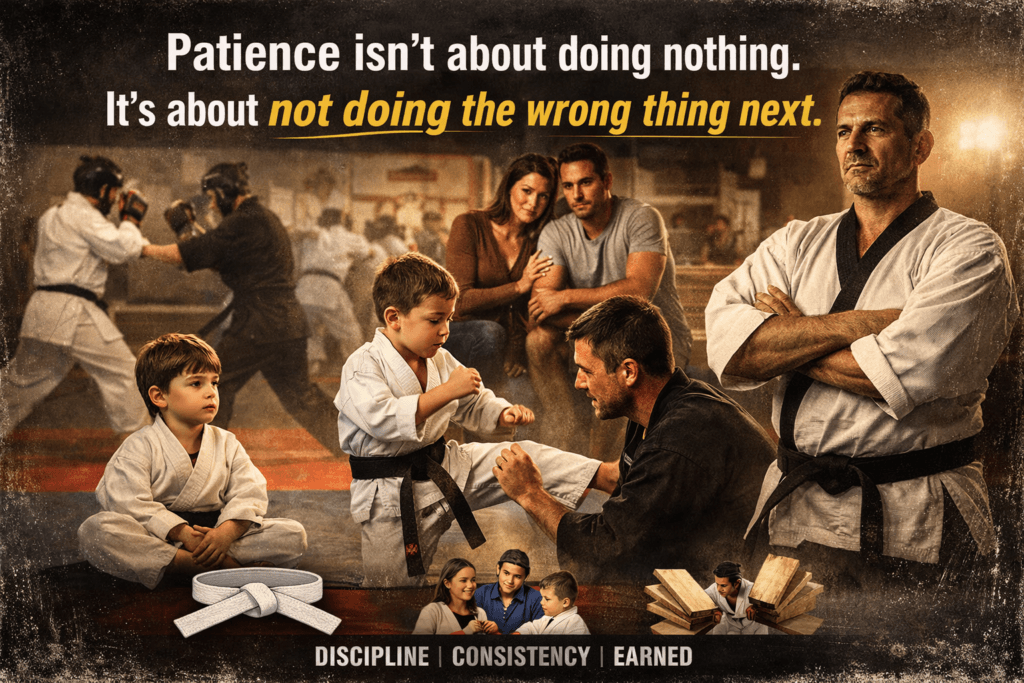
There’s a phrase that’s been sitting with me lately:
“Patience isn’t about doing nothing. It’s about not doing the wrong thing next.”
At first glance, patience feels slow. Passive. Like waiting. But that’s not how we teach it on the mat—and it’s not how it works in leadership.
The White Belt Problem
Every student wants to be a black belt. Not someday—now.
They want the confidence, the skill, the respect. They want to move like the advanced students, spar like the leaders, and wear the belt that represents mastery. But what they don’t want… is the reps. The awkward phases. The corrections. The frustration of not getting it right the first (or tenth) time.
And here’s the truth: You don’t become a black belt by wanting it more. You become a black belt by not skipping what builds it.
The Parent Perspective
Parents want their child to be confident. Focused. Disciplined. They see the black belts—how they carry themselves, how they speak, how they perform—and they think:
“That’s what I want for my child.”
And they’re right.
But where it can get off track is the timeline. Because sometimes that expectation shows up six weeks in. When their child is still learning how to stand at attention. Still figuring out left from right. Still building the habits that black belts make look effortless.
And here’s the truth we have to help parents understand:
Black belt confidence is not taught. It’s earned through experience.
It’s built through small wins. Through struggle. Through sticking with something when it’s hard. The same way you can’t rush a child from kindergarten to high school…you can’t rush them from white belt to black belt.
What parents should look for early on isn’t perfection.
It’s progress. Are they listening a little better than last week? Are they trying when things get difficult? Are they starting to believe in themselves just a little bit more?
That’s the real win. Because if we stay patient—and we keep making the right next move—those small changes compound into something powerful.
One day, without even realizing when it happened…They become the black belt you saw on day one.
The Instructor Version of the Same Story
It doesn’t stop with students. Instructors want the title. The income. The influence.
They want to lead classes, be respected, and build a career. But leadership isn’t given because you want it.
It’s earned through consistency when no one is watching. Through showing up early. Through doing the little things right—over and over again. That’s skin in the game. And there’s no shortcut for it.
What Patience Actually Looks Like
Patience isn’t sitting back and waiting for success to arrive. It’s actively choosing discipline over impulse.
It’s a white belt doing a basic front kick… again… and again… and again—until it’s right.
It’s a parent seeing a black belt and realizing that it’s unfair to compare your child’s chapter 1 to someone else’s chapter 10.
It’s an instructor choosing to master one class, one connection, one student at a time—rather than chasing recognition too early.
It’s saying: “I’m not going to rush this… because rushing this will cost me later.”
The Hidden Cost of Impatience
Impatience doesn’t just slow you down. It leads you to make the wrong next move. Skipping fundamentals. Chasing titles before you’re ready. Trying to “look” like a black belt instead of becoming one.
And the dangerous part? You can get away with it… for a while. Until the moment comes where your foundation is tested—and it’s not there.
The Right Next Step
On the mat, progress isn’t built in leaps. It’s built in correct repetitions over time.
In leadership, it’s the same. You don’t need to do everything today. You don’t need to have it all figured out. You don’t need to rush the process.
You just need to make sure your next step is the right one.
Final Thought
Patience isn’t about standing still. It’s about moving forward… on purpose. Slow enough to build it right. Disciplined enough to not cut corners. Focused enough to trust the process.
Because black belts aren’t created by speed. They’re created by standards. And standards take time.
