
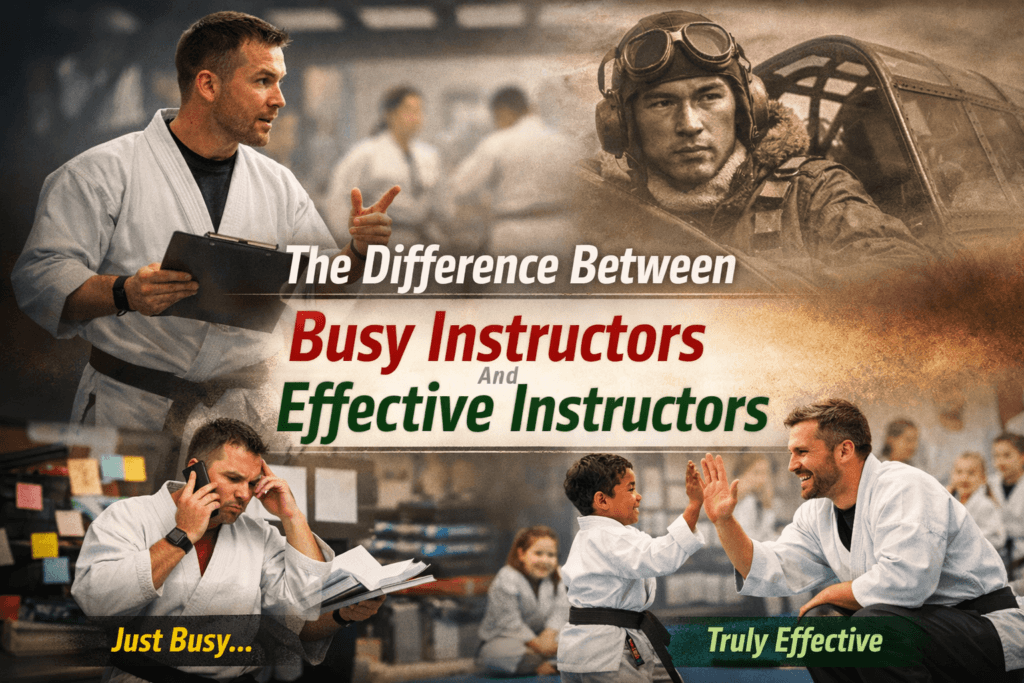
A few years ago I heard a story about a kamikaze pilot flying his tenth mission. He was busier than everyone else in the squadron. He was checking instruments, adjusting controls, looking intense, and flying all over the sky.
But there was one problem.
He was supposed to crash the plane into the target.
He looked incredibly busy, but he wasn’t accomplishing the mission.
I think about that story a lot when I look at martial arts schools. Not because anyone is flying planes into ships, obviously, but because being busy is one of the easiest traps for instructors and leaders to fall into.
They are constantly doing things. Walking around the school. Talking. Answering questions. Straightening equipment. Checking the schedule. Standing at the front desk. Running in and out of the office.
Busy. Very busy.
But sometimes when you zoom out and ask a simple question — “What actually moved the school forward today?” — the answer is surprisingly unclear.
Activity vs. Responsibility
Most martial arts schools do not struggle because the team is lazy. They struggle because the team is busy doing the wrong things.
Instructors are active. They are present. They are moving.
But activity is not the same thing as responsibility.
Every martial arts school really has two core missions: deliver amazing classes and build strong relationships with students and parents. That’s it. Everything else is secondary.
If the classes are exciting, structured, and transformational, students stay. If instructors build real relationships with families, the school grows.
But when instructors drift into “busy mode,” something strange happens. They start focusing on things that feel productive but don’t actually move the mission forward.
Organizing the office. Tweaking tiny details. Standing around the lobby. Talking about plans instead of executing them.
Again, they look busy, but the mission isn’t getting accomplished.
The Instructor’s Real Job
If you’re an instructor in a martial arts school, your job is actually very simple. Not easy, but simple.
Your job is to change lives through great classes and great relationships.
That means leading the floor with energy and authority, coaching students with attention and care, encouraging effort and discipline, and talking with parents before and after class.
It means knowing your students’ names, their goals, and sometimes even their struggles. It means creating an environment where people feel seen and supported.
When those things happen consistently, a school becomes something special. Retention goes up. Confidence grows. Parents talk about the program. The culture becomes magnetic.
But none of that happens from sitting in the office or hovering in the lobby.
It happens on the floor and with people.
Leadership Can’t Be Delegated
There’s another lesson inside this.
Leadership responsibilities can’t be delegated away.
A chief instructor who stops leading classes is no longer leading. A program director who stops connecting with families is no longer directing the program. The titles may stay the same, but the mission quietly stops happening.
Great martial arts schools work because the leaders are deeply involved in the experience. They’re on the mat. They’re in conversations. They’re building the culture in real time.
A Simple Question
If you work in a martial arts school, here’s a question worth asking yourself at the end of the day:
Did what I did today help students grow or help families feel more connected to this school?
If the answer is yes, you’re doing the work that matters.
If the answer is no, you might have just spent the day being busy.
And busy can feel productive.
But as that old story reminds us, even a very busy pilot can still miss the mission.
In great martial arts schools, the goal isn’t to look busy.
The goal is to change lives. And that only happens when we stay focused on the mission.
